Here's exactly what happens at Huikaicheng between a panel arriving at our production line and a finished screen leaving in a box destined for your workshop. I'm writing this partly because transparency builds better long-term business relationships, and partly because I want to give you a useful benchmark the next time a new supplier tells you their quality is "guaranteed."
Stage 1 - Incoming panel inspection: origin verification and visual check
Before any screen enters the assembly line, the panel batch is verified against the purchase order. We check panel manufacturer, model compatibility, and production lot number. This matters more than it might sound.
In a market where panels from different production runs - sometimes different factories, sometimes different IC versions - get mixed together without disclosure, lot traceability is your first line of defence against inconsistent batches. A supplier who can't tell you which production lot a batch of panels came from cannot isolate a quality problem if one emerges.
Visual inspection at this stage covers the panel glass surface for pre-existing scratches or pressure marks, the condition of the backlight components, and the state of the FPCB. Any panels with kinked or bent flex circuit traces are rejected here, before they consume any downstream labour.
Typical incoming reject rate: 0.8–2.5%, depending on the panel source and model.
Stage 2 - OCA lamination and autoclave bonding
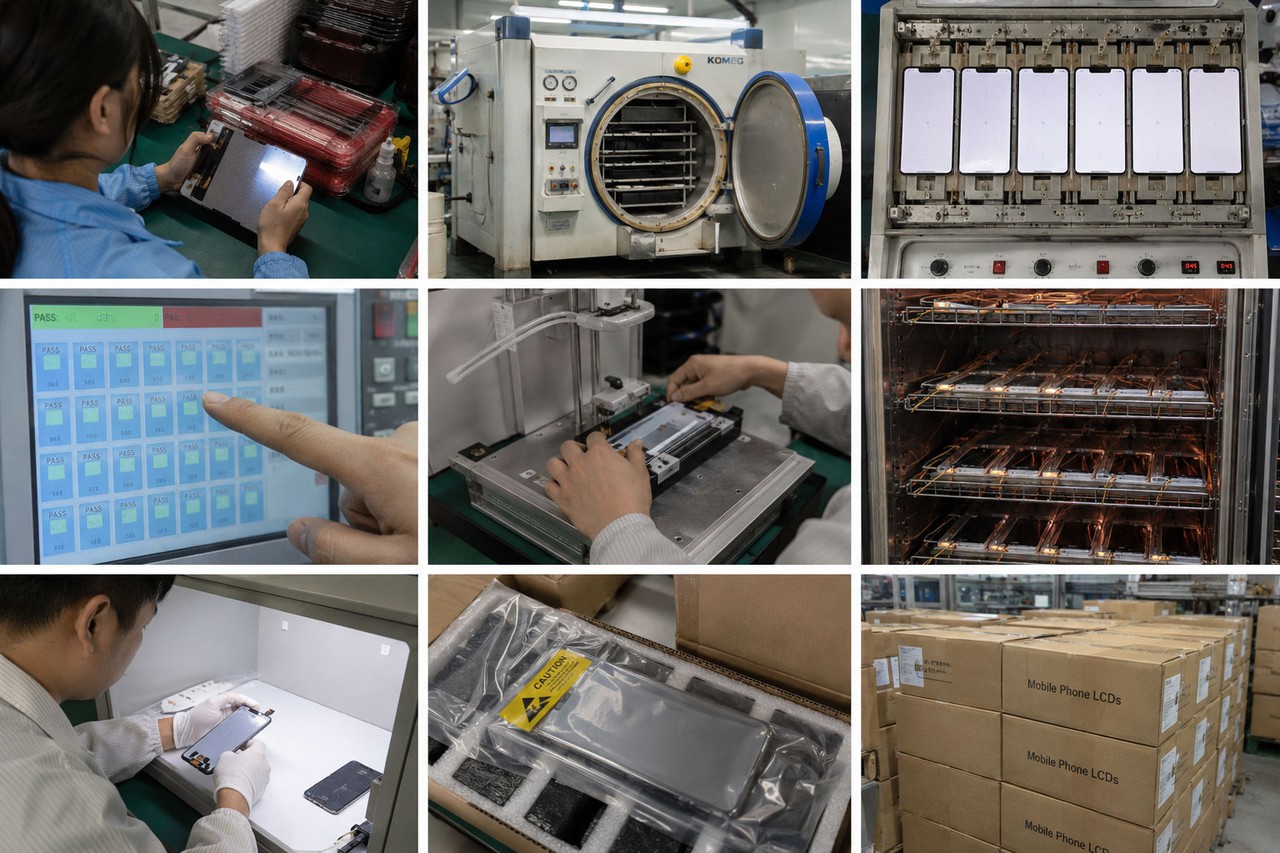
For models that require front glass lamination - which is every current model in our range - panels go through vacuum OCA bonding in a clean-room environment. The critical variable here is the autoclave cycle that follows lamination.
Insufficient pressure or temperature during autoclave results in micro-bubbles trapped between the outer glass and the panel. These bubbles are often invisible at room temperature on the day of assembly. They become visible within four to eight weeks as the phone's normal operating heat causes the adhesive to shift slightly. By the time your customer notices them, the phone has been back in circulation for a month and the warranty conversation is awkward.
We run a 45-minute autoclave cycle at 60°C and 5.5 bar. After each batch, we pull five sample units and inspect them under a high-angle light to check specifically for bubble formation at the corners and edges, where thermal expansion stress concentrates. If more than one in twenty sampled units shows edge bubbling, the entire batch goes back for re-autoclave before proceeding.
Some suppliers skip autoclave entirely and use room-pressure bonding, which produces screens that look perfectly clean on day one. If your current screens are generating bubble complaints at the six-to-eight-week mark after installation, ask your supplier directly about their autoclave process and parameters.
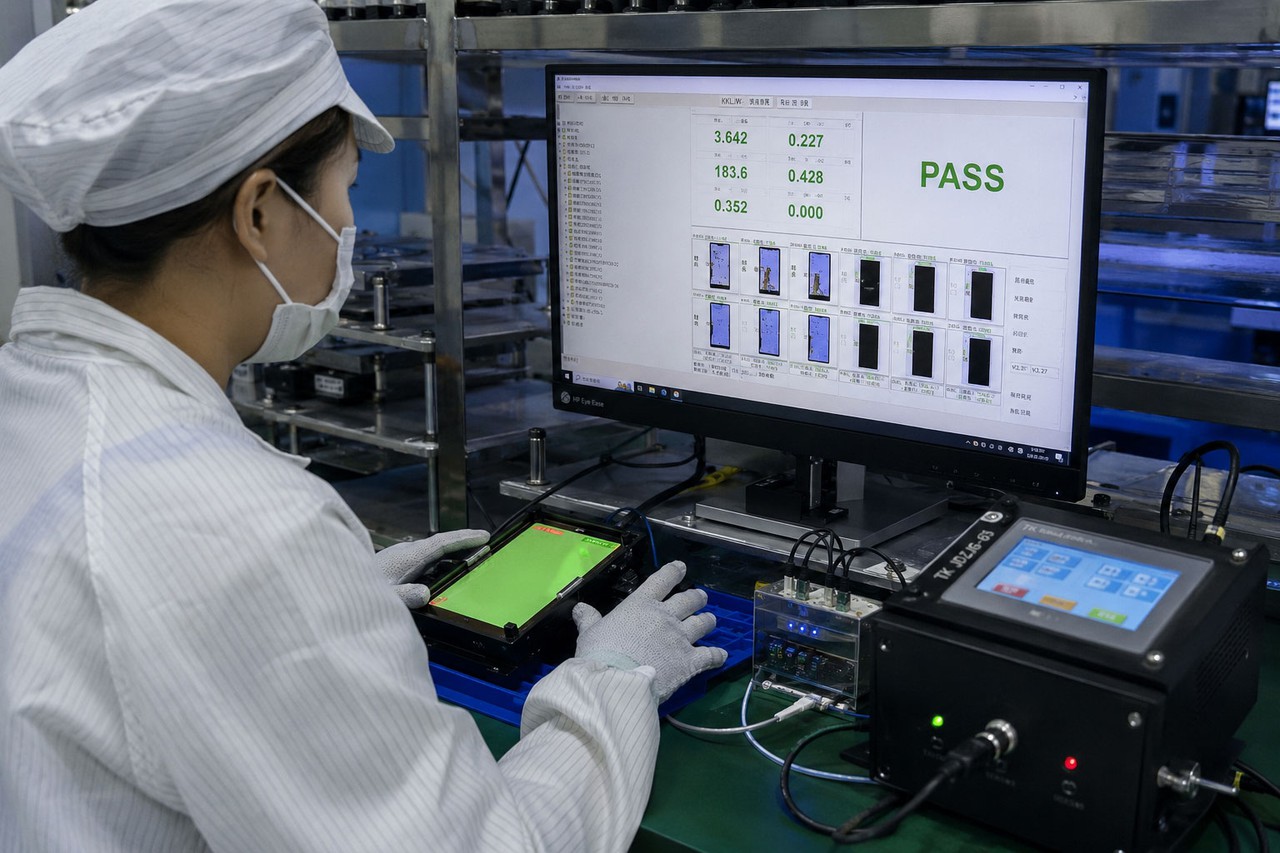
Stage 3 - 100% power-on display test
Every single unit is connected to a test jig and powered on. This is the stage that most suppliers mean when they say "100% tested" - but there's a significant difference between a screen that someone glanced at for two seconds and one that was run through a structured display sequence.
Our power-on test runs the following sequence on every unit:
- Full white display - checks for dead pixels. Any pixel not displaying white on a full-white screen is flagged immediately.
- Full black display - checks for bright or stuck pixels, and for backlight leakage patterns that only show against a dark background.
- 50% grey at three brightness levels - checks backlight uniformity across the panel surface. A screen that looks even at full brightness can still show pronounced hot spots or dimmer corners at 30% brightness, which is where most people actually use their phones.
- Solid red, green, and blue fills - checks colour channel uniformity and catches dead sub-pixels that a full-white test might miss.
Moving gradient pattern - checks for horizontal or vertical line artefacts, which are a common failure mode on TFT panels with damaged driver ICs.
Rejection thresholds: zero dead pixels within the central 80% of the screen surface. Up to two dead pixels in the extreme outer ten millimetres of the perimeter are classified as Grade B, discounted accordingly, and clearly labelled. Backlight uniformity variance exceeding 15% across the panel surface is an automatic reject regardless of pixel condition.
Stage 4 - 5-point digitiser calibration and accuracy test
Touch testing requires more than confirming the digitiser layer is electrically connected. Our process runs a five-point calibration check - top-left, top-right, centre, bottom-left, bottom-right - against a known coordinate grid. The acceptable tolerance is plus or minus two millimetres at each test point. Any unit showing consistent offset greater than two millimetres is rejected.
We also run a flex-cycle test on the FPCB connector: the connector is seated, released, and reseated five times, with a touch functionality check after each cycle. This simulates the installation process - specifically the reality that technicians don't always seat a connector perfectly on the first attempt - and surfaces connectors that are marginal at the microscopic level. These are screens that would pass a standard single-connection bench test but fail after a real-world install.
Finally, each unit sits on the test jig for sixty seconds with no input applied. Any unit that registers phantom touches during this monitoring period is flagged as a ghost touch failure and rejected.
Stage 5 - 48-hour burn-in soak test (new models and new panel batches)
For every new iPhone model we add to our production line, and for any new panel supplier batch on existing models, we run a 48-hour burn-in test on a sample of twenty units. Screens are powered on continuously at 50% brightness at an ambient temperature of 35°C - simulating a phone in active use in a warm environment.
This test is specifically designed to catch two failure modes that pass a standard bench test without difficulty. The first is IC thermal failure: a marginal driver IC or touch controller that performs within spec when cool but degrades under sustained heat. The second is backlight driver instability: dimming or flickering that only appears after extended runtime, typically presenting as a slow, barely perceptible brightness drift.
Both modes show up as customer returns at the three-to-six week mark after installation. That's the window that does the most damage to supplier relationships, because by that point the customer is already frustrated, the repair shop is absorbing a warranty cost, and the conversation about whether the screen or the installation was at fault is genuinely difficult to resolve. We'd rather catch it here at the burn-in stage than anywhere downstream.
Stage 6 - Final human visual inspection under standardised lighting
This is the one stage that automated testing genuinely cannot replace. Each screen is inspected by a trained QC technician under a standardised 6500K lightbox at both 45-degree and 90-degree angles. This catches surface scratches introduced during assembly handling, small adhesive contamination spots that only become visible at oblique angles, minor edge chips or delamination that escaped incoming inspection, and frame alignment defects.
Our QC technicians work to a standard that I describe to new hires this way: if you would personally be annoyed to receive this screen as a buyer, it doesn't pass. That's harder to audit than a measurement threshold, but it's the filter that your end customers are actually applying when they look at a repaired phone under a bright light.
Stage 7 - ESD packaging and shipment documentation
Screens that pass all six prior stages are immediately placed in individual anti-static shielding bags - not standard PE bags, which provide no ESD protection - before leaving the inspection area. They go into individual foam-padded inner boxes, then into an outer carton with sufficient void fill to prevent movement during air freight or courier transit.
A screen that passes every QC stage and then gets damaged by inadequate shipping packaging is still a QC failure. It just happened at the last step.
Each carton ships with a batch quality certificate listing the panel source, production lot number, and the QC inspection date. This documentation is your protection in any batch quality dispute, and the fact that we provide it without being asked is a signal about how seriously we take traceability.
Seven questions to ask any iPhone LCD supplier before committing to volume
Use this process as a benchmark. You don't need every supplier to do exactly what we do - but you do need to understand where their process stops and your own quality risk begins.
"Do you run autoclave bonding, and what are your cycle parameters?" If the answer is "we laminate in-house but don't autoclave," expect bubble returns within eight weeks of installation.
"What is your dead pixel rejection threshold?" Zero tolerance in the display area is standard for Grade A product. Anything more permissive should be sold and labelled as a lower grade.
"Do you run per-unit touch calibration testing, or just connectivity testing?" These are different things. Connectivity confirms the touch layer is functioning. Calibration confirms it's functioning accurately. A supplier who can't explain this distinction isn't doing calibration testing.
"What is your outgoing defect rate for the last three batches of this specific model?" Any manufacturer running measurement-based QC tracks this number. If they can't answer, their QC is visual-only.
"Do you run burn-in testing when you first add a new model to your line?" Only relevant if you're one of the early buyers of a model they've recently started producing - but this is exactly when thermal and backlight stability failures are most likely to slip through.
"Are screens packed individually in ESD shielding bags?" Standard PE bags are not ESD protection. This matters for the digitiser IC and is a quick indicator of how seriously a supplier takes the electronics handling side of their process.
"Can you provide a batch QC certificate with the shipment?" This protects you in any dispute situation and tells you whether the factory has traceability infrastructure in place - or is operating batch-by-batch with no documentation.
We're not the only manufacturer doing rigorous QC in Shenzhen. But we are one that can walk you through every stage of the process in this kind of detail - and back it up with data when you ask. If you're evaluating our iPhone 12 or iPhone 14 LCD range, or any other model in our catalogue, we're happy to share batch QC data for current stock and arrange a sample order so you can run your own verification before committing to volume.